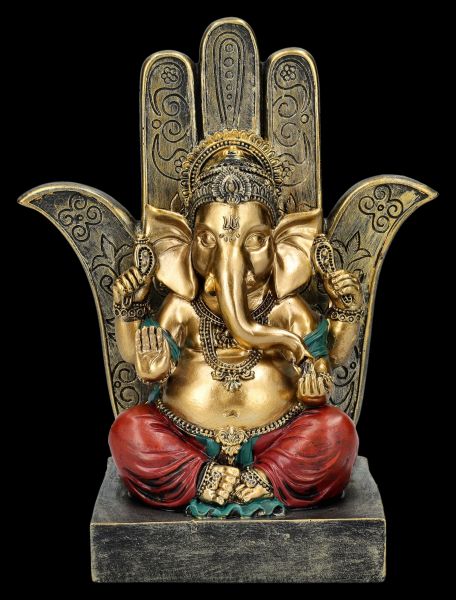
Ganesha Statues: Meaning and Symbolism
Ganesha, also known as Ganesh, Ganapati or Vinayaka, is the son of Shiva and Parvati. He is associated with wisdom, success and overcoming obstacles, and is traditionally invoked at the start of important undertakings. His typical attributes include a large belly, a bowl of modaks, a noose and an elephant goad, and his broken tusk: according to legend, Ganesha used it to write down the epic Mahabharata as the sage Vyasa dictated it – statues showing him with a scroll draw on exactly this story.
Seated, Dancing or Musician: Forms of Ganesh
Ganesha most often appears seated on a lotus flower or throne, one hand frequently raised in blessing. As Nritya Ganapati he dances, and as a musician he plays the sitar, tabla, harmonium, shehnai or flute – a popular motif, as Ganesha is traditionally invoked at the start of performances and other undertakings to ask for success. In the special form of Mayureshvara he appears, unusually, riding a peacock; his usual mount is the mouse or rat. The collection includes hand-painted Ganesh figures as well as gold, silver and bronze finishes, from miniatures to larger altar statues, and sets of three or twelve figures.
Ganesha Décor: Incense Holders, Tea Lights and Boxes
With backflow incense burners, the smoke from an incense cone flows downwards like a waterfall around the figure. Tea light holders and trinket boxes featuring Ganesha complete a home altar or meditation corner. In many Hindu Diwali traditions, Ganesha is worshipped together with Lakshmi; other deities such as Shiva, Krishna and Durga can be found among the Hindu god statues, and Buddha and feng shui in Asian spiritual décor.
FAQ about Ganesha Statues
Why does Ganesha have an elephant head?
There are several stories. The best known comes from the Puranas: Parvati created Ganesha and had him guard her chamber. Shiva, who did not recognise him, struck off his head in a quarrel and afterwards replaced it with the head of an elephant. The elephant head is often interpreted as a sign of wisdom and intelligence.
Why does Ganesha ride a mouse?
The mouse, Mushika in Sanskrit, is Ganesha's traditional mount, or vahana. Its symbolism is interpreted in different ways. It often stands for restlessness, desire or the small and hard-to-control, which Ganesha masters.
When is Ganesh Chaturthi celebrated?
Ganesh Chaturthi is the most important festival in honour of Ganesha and, following the Hindu lunar calendar, usually falls in August or September. It is celebrated for up to ten days, especially in the Indian state of Maharashtra; at the end, Ganesha statues are carried in processions and immersed in water.