Egyptian God Figurines - a Complex Pantheon
Ancient Egypt had an extensive pantheon in which deities held different roles, forms and cult centres. Many were associated with sacred animals and depicted in human form with an animal head – a hallmark of Egyptian iconography. Horus, Anubis, Bastet and Isis have their own pages: Horus, Anubis, Bastet and Isis.
Osiris Figurines: the Egyptian God of the Dead
Osiris was regarded as ruler of the afterlife and judge of the dead. He is usually depicted in mummiform shape, with green or black skin as a sign of fertility and rebirth, the tall atef crown on his head and the crook and flail in his hands. According to tradition, he was killed by his brother Seth and restored and brought back to life by Isis; from then on he ruled over the realm of the dead. His most important cult centre was Abydos, and the djed pillar, a symbol of stability, was associated with him.
Sekhmet Figurines: the Egyptian Lioness Goddess
Sekhmet, written Sachmet in German, is depicted as a woman with a lion's head and a sun disc. She was regarded as a powerful goddess of war and plague, yet also as a healer – her priests often served as physicians. According to one myth, the sun god Ra sent her out to punish humankind and could only appease her with beer dyed red. Sekhmet is linked to Bastet through her feline form and partly overlapping qualities, although both were independent goddesses with separate cults.
Ra, Thoth, Hathor and the Other Egyptian Gods
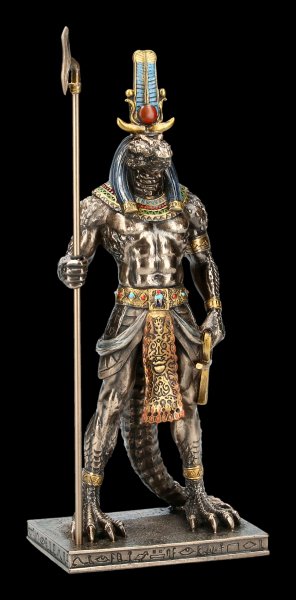
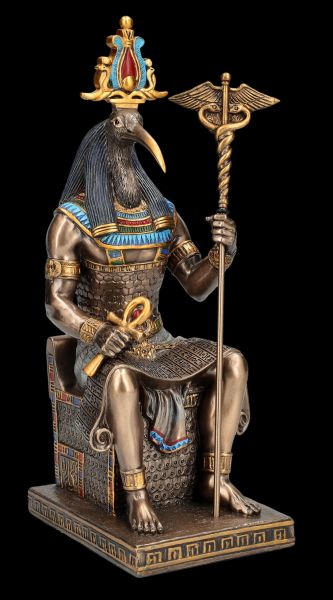
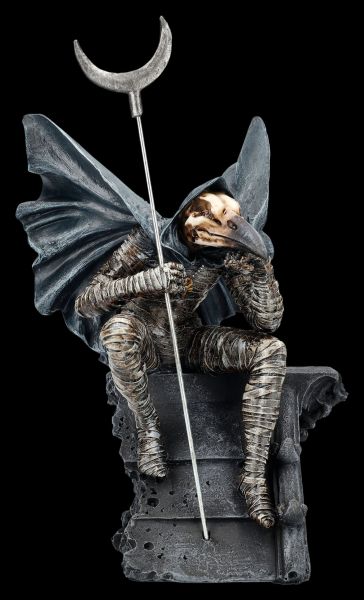
Ra, the sun god, appears in various forms, often with a sun disc and in falcon-headed form. Thoth, god of wisdom and writing, is often depicted with the head of an ibis. Hathor, goddess of love, music and joy among other things, frequently wears cow horns and a sun disc. Maat embodies truth, justice and cosmic order and can be recognised by her ostrich feather. Seth stands for powerful and chaotic forces, but could also act as a protector, and bears the head of an enigmatic creature that cannot be clearly identified with any animal. Sobek, the crocodile god, was associated with water, fertility and power. Amun rose to become one of the most important gods of Egypt, especially in the New Kingdom, and often wears a tall double-plumed crown. Khnum, a ram-headed creator god, and Khonshu, the moon god, complete the group.
FAQ about Egyptian God Figurines
Which Egyptian gods are depicted as figurines?
Among the most popular Egyptian gods as decorative figurines are Osiris, Sekhmet, Ra, Thoth, Hathor, Maat, Seth, Sobek, Amun, Anubis, Horus and Bastet. Many are shown in human form with an animal head – falcon heads, for example, for Horus and various sun deities, the jackal head for Anubis, the cat head for Bastet and the lion head for Sekhmet.
Who was the Egyptian god of the dead?
Osiris was regarded as ruler of the realm of the dead and judge of the deceased. Anubis, the god of embalming and companion of the dead who watched over the scales at the judgement of the dead, was also closely associated with death.
How can I recognise Egyptian god figurines?
Egyptian god figurines can usually be recognised by their characteristic animal head or headdress: sun disc, atef crown, ostrich feathers or cow horns. Symbols of rule such as the crook, flail or staff are also typical attributes. All gods and pharaohs can be found among the Egyptian figurines.